One of the most common questions we hear from aspiring authors is:
“Why does publishing a book cost so much?”
It’s a fair question.
After all, many authors have spent months—or even years—writing their manuscript. When they begin exploring publishing options, they are often surprised to discover that professional publishing services can range from a few thousand dollars to well over $15,000 depending on the scope of the project.
The confusion usually comes from a misunderstanding of what publishing actually involves.
Many people assume publishing is simply a matter of uploading a file to Amazon and ordering a few printed copies. While anyone can technically publish a book today, producing a book that looks professional, reads well, reaches readers, and creates long-term opportunities for the author requires much more than printing pages.
A successful publishing project often includes not only a print book and ebook, but also an audiobook, a marketing strategy, and a growing author platform.
Let’s pull back the curtain and look at what goes into creating a professional-quality book.
The Manuscript Is Only the Beginning
Writing the manuscript is a major accomplishment. For most authors, it is also the longest part of the process. In some cases, authors begin with ghostwriting and later move into developmental editing as the manuscript takes shape.
However, once the manuscript is complete, the publishing work begins.
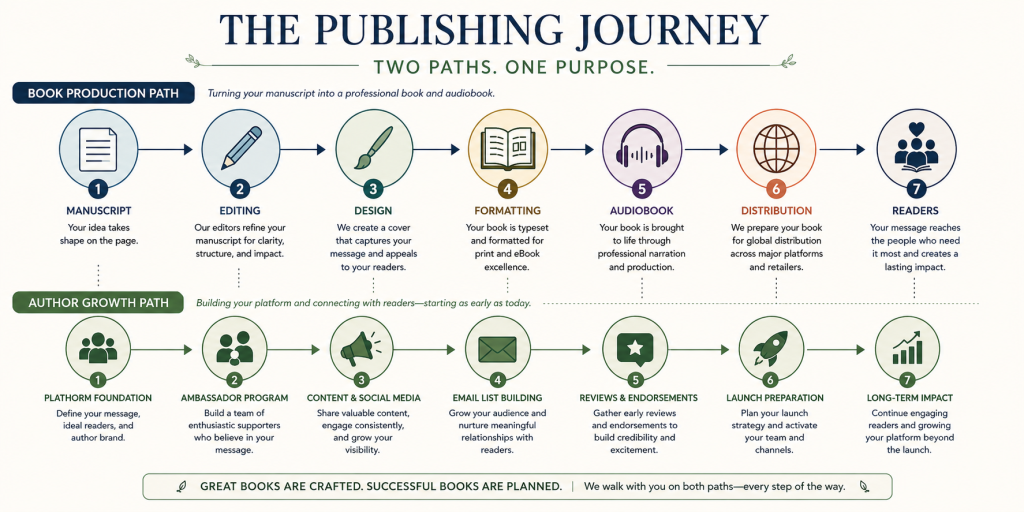
A professional book often passes through multiple stages before it reaches readers:
- Manuscript evaluation
- Developmental editing
- Line editing
- Copy editing
- Proofreading
- Cover design
- Interior layout and typesetting
- Ebook formatting
- Audiobook production
- Distribution setup
- Author platform development
- Review acquisition
- Social media strategy
- Launch planning
- Project management
Not every book requires every service, but every successful book requires careful attention to quality.
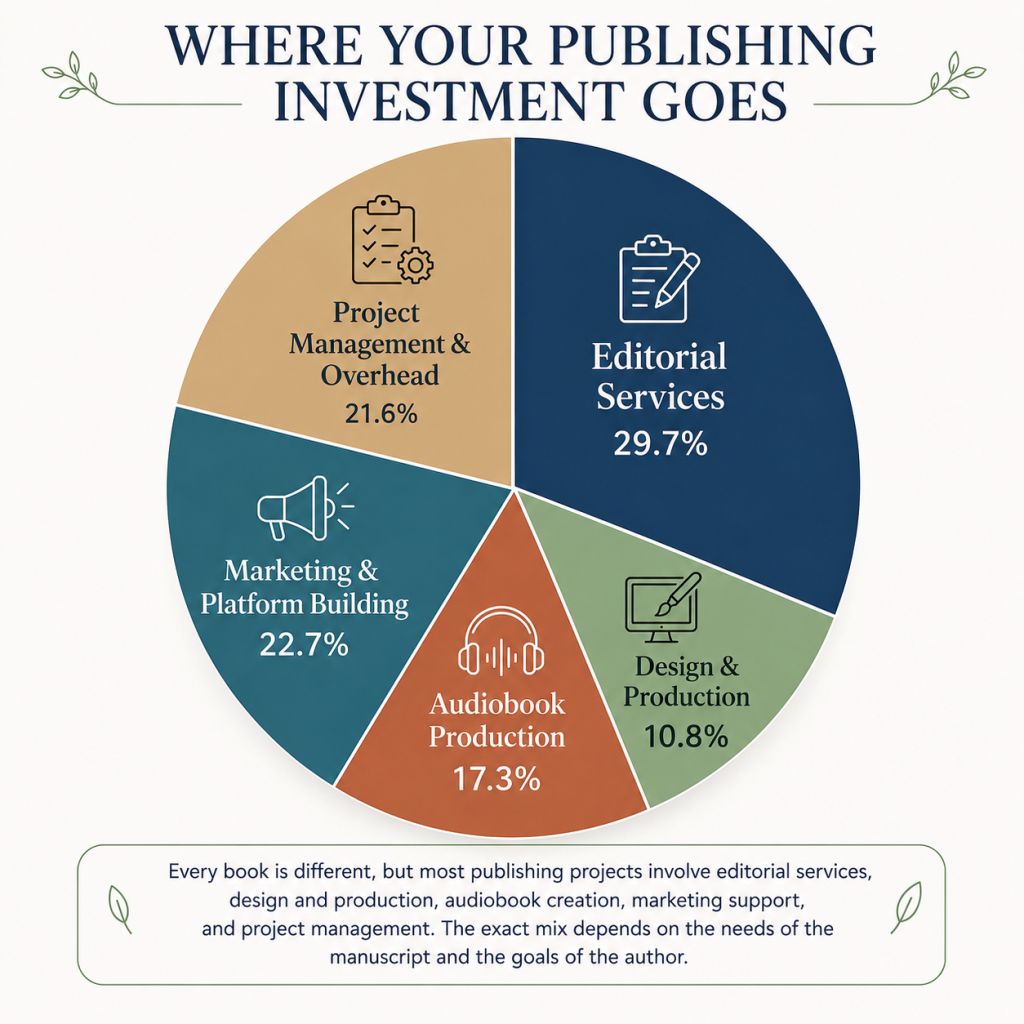
Understanding the Major Publishing Costs
| Service | Typical Cost Range |
| Ghostwriting | $9,000-$25,000+ ($.25-$1.25/word) |
| Developmental Editing | $1,500–$8,000+ ($.035-$.075/word) |
| Line Editing | $800–$4,000+ ($.035-$.06/word) |
| Copy Editing | $500–$3,000+ ($.02-$.055/word) |
| Proofreading | $300–$2,000+ ($.01-$.045/word |
| Cover Design | $500–$2,500+ |
| Interior Layout | $500–$2,500+ ($2.5-$15/page) |
| Ebook Formatting | $100–$500+ ($.50-$1/page) |
| ISBN & Distribution Setup | $100–$500+ |
| Project Management | $1000-$2500+ |
| Marketing Support | $500-$5000+ |
Ghostwriting
Not every author begins the publishing process with a completed manuscript.
Some people have a powerful message, a compelling life story, or years of expertise to share but lack the time, writing experience, or confidence to turn those ideas into a book.
That’s where ghostwriting comes in.
A ghostwriter works closely with the author to transform their knowledge, experiences, and ideas into a professionally written manuscript while preserving the author’s voice and vision.
The process may include:
- Interviews and conversations
- Research and fact gathering
- Manuscript planning and outlining
- Chapter development
- Writing and revisions
- Collaboration and feedback sessions
Contrary to popular belief, ghostwriting is not simply someone else writing a book for you. The most effective ghostwriting projects are highly collaborative. The author’s ideas, experiences, expertise, and personality remain at the center of the project.
Ghostwriting is often used by:
- Business leaders
- Pastors and ministry leaders
- Coaches and consultants
- Speakers
- Professionals with specialized expertise
- Individuals with compelling personal stories
Because ghostwriting involves extensive interviews, planning, writing, and revision, it is often one of the largest investments in the publishing process. However, for many authors, it provides a path to publication that might not otherwise be possible.
A well-executed ghostwriting project allows an author to share their message with readers while working alongside an experienced writer who helps bring that message to life.
Developmental Editing
Developmental editing focuses on the structure and effectiveness of the book.
A developmental editor looks at questions such as:
- Is the message clear?
- Are the chapters organized logically?
- Are important ideas fully developed?
- Are there sections that should be removed, expanded, or rearranged?
This is often the most intensive form of editing because it addresses the foundation of the manuscript itself.
Line Editing
Line editing improves the flow and readability of the writing.
The editor examines each paragraph and sentence, looking for ways to improve clarity, eliminate repetition, strengthen transitions, and create a more engaging reading experience.
Good line editing helps the author’s voice shine through while making the manuscript easier to read.
Copy Editing
Copy editing focuses on correctness.
This stage addresses:
- Grammar
- Punctuation
- Spelling
- Consistency
- Word usage
- Basic fact-checking
Many authors are surprised by how many small issues remain in a manuscript even after several rounds of self-editing.
Proofreading
Proofreading is the final quality check before publication.
Once the book has been laid out and formatted, a proofreader reviews the final pages to catch any remaining errors before printing.
This step helps ensure a polished, professional final product.
Cover Design: More Important Than Most Authors Realize
Many authors have heard the phrase, “Don’t judge a book by its cover.”
Readers do it anyway.
A book cover is often the first thing a potential reader sees. In online stores, readers frequently make purchasing decisions within seconds based on the cover alone.
Professional cover design requires:
- Market research
- Genre awareness
- Typography selection
- Image sourcing
- Layout expertise
- Print and ebook specifications
An effective cover doesn’t just look attractive—it communicates the book’s promise to the right audience.
Interior Design and Typesetting
The inside of the book matters too.
Interior design involves:
- Page layout
- Typography
- Chapter design
- Headers and footers
- Margins and spacing
- Image placement
- Print specifications
A professionally typeset book feels comfortable and inviting to read. A poorly formatted book can frustrate readers and diminish the credibility of the author’s message.
Ebook Conversion and Distribution
Today’s readers consume books in multiple formats.
After the print edition is complete, the book may also need:
- Kindle formatting
- EPUB conversion
- Distribution setup
- Metadata optimization
- ISBN management
These technical details are often invisible to readers but are essential to making a book available through major retailers.
Audiobooks: The Opportunity Many Authors Miss
One of the fastest-growing segments of the publishing industry is audiobooks.
Readers are increasingly consuming books while commuting, exercising, traveling, or completing everyday tasks. For many people, listening has become their preferred way to experience a book.
Unfortunately, many authors stop after publishing a print book and ebook, leaving a significant opportunity untapped.
Producing an audiobook may involve:
- Narration
- Audio engineering
- Editing
- Mastering
- Distribution setup
- Platform compliance reviews
Like print publishing, audiobook production requires specialized skills and quality control.
While not every book is a perfect fit for audio, many authors discover that audiobook sales reach readers they would not have reached otherwise.
At Cypress Springs Press, we strongly encourage authors to consider audiobook production as part of their overall publishing strategy rather than treating it as an afterthought.
The Cost Most Authors Never See: Project Management
One of the least visible—but most important—parts of publishing is project management.
Someone must coordinate the process.
That includes:
- Managing schedules
- Coordinating editors and designers
- Tracking revisions
- Communicating with the author
- Preparing files for production
- Overseeing quality control
Without strong project management, even talented professionals can struggle to keep a project moving smoothly.
Publishing the Book Is Only Half the Journey
One of the biggest misconceptions in publishing is that books automatically sell once they are available online.
The truth is that publishing a book and marketing a book are two very different activities.
A professionally produced book gives an author something worth promoting. Marketing helps readers discover it.
Many authors spend years writing a manuscript and only a few days thinking about how readers will find it.
That’s why we encourage authors to begin building visibility before their book launches.
Some of the most effective activities include:
- Building an email list
- Establishing a social media presence
- Gathering reader reviews
- Developing relationships with potential readers
- Creating launch teams
- Growing a community around the book’s message
Books rarely succeed because they exist. They succeed because readers hear about them.
Why We Encourage Authors to Build an Audience
Many authors assume they need thousands of followers before publishing a book.
In reality, what matters most is building meaningful connections with the right readers.
One of the ways we help authors do this is through our Ambassador Program.
The purpose of the program is not to create internet celebrities. The purpose is to help authors develop a community of engaged readers who are excited about their message and eager to support their book launch.
The program helps authors:
- Build an author platform
- Grow an email list
- Create engaging content
- Connect with potential readers
- Develop launch support teams
- Generate early momentum for a book release
Authors who begin building an audience before launch are often in a much stronger position than authors who wait until their book is published to start marketing.
Why Do Publishing Quotes Vary So Much?
Authors often receive dramatically different quotes from different companies.
Why?
Because not all publishing services are the same.
Some companies provide only basic formatting and distribution.
Others provide extensive editing, custom design, audiobook production, project management, platform-building support, marketing guidance, and launch preparation.
A lower price does not automatically mean a better value, just as a higher price does not automatically guarantee better results.
The key is understanding exactly what services are included and how those services support your publishing goals.
How We Approach Publishing at Cypress Springs Press
At Cypress Springs Press, we believe authors deserve transparency.
Every manuscript is different.
A polished manuscript may require only light editing and production services. Another project may benefit from substantial editorial development before publication.
For that reason, we create customized proposals based on the specific needs of each book rather than forcing every author into the same package.
We also believe that publishing should be viewed as more than simply producing a book. Our goal is to help authors create a professional product, build a platform, connect with readers, and maximize the opportunities their message can have in the marketplace.
Our goal is simple:
To help authors create books that serve their readers well and reflect the quality of the message they want to share with the world.
Final Thoughts
Publishing isn’t expensive because printing books is expensive.
Publishing costs what it does because creating a professional book, audiobook, and marketing foundation requires skilled people investing significant time, experience, and expertise into the process.
The good news is that authors no longer have to navigate that journey alone.
The more you understand the publishing process, the better equipped you’ll be to make wise decisions about your book, your budget, and your publishing goals.
And that’s exactly why we’re committed to sharing what many publishers prefer to keep behind the curtain.